
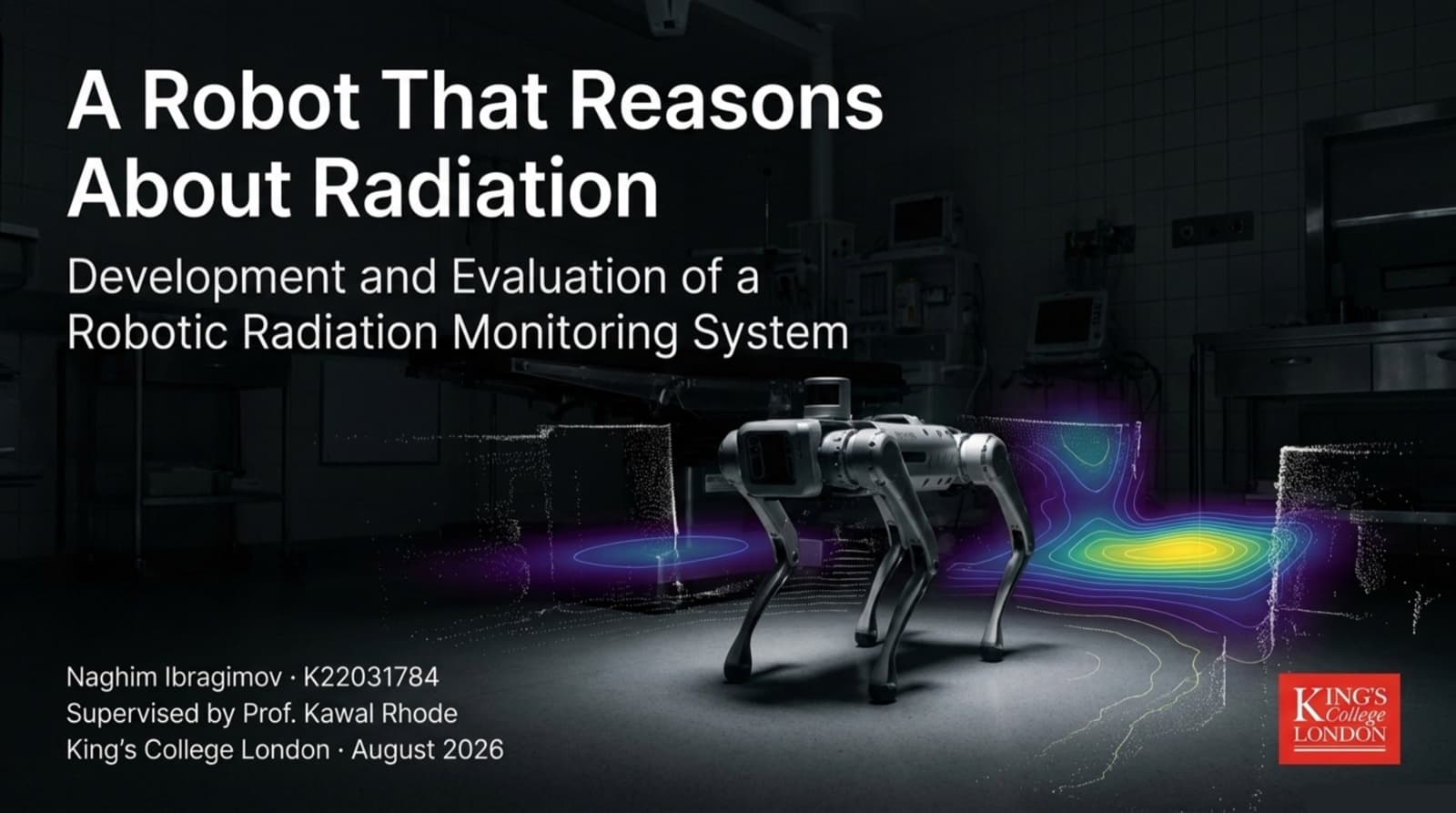
MSc Dissertation — Quadruped Robotic Radiation Monitoring System
A Unitree Go2 quadruped that reasons about the radiation field rather than just recording it: Bayesian field estimation with Poisson counting noise, information-driven measurement selection, supervised autonomy, and real radioactive waste localized to within 12 cm using a £30 uncalibrated detector.
Project Overview
MSc individual project at King's College London (supervised by Prof. Kawal Rhode). Hospital radiation surveys are done by hand — slow, sparse, and the surveyor stands inside the hazard. This project puts the survey on a Unitree Go2 quadruped and replaces blind recording with statistical reasoning: a field model estimates the radiation rate everywhere in the room together with its own uncertainty, using measurement noise that reflects the detector's counting statistics. From that model the robot chooses each next measurement position by weighing expected information against walking distance, decides how long to dwell from the counts needed for a trustworthy reading, and ends the survey when no remaining measurement would repay the effort of reaching it. Every movement is proposed to an operator who approves, rejects, or halts it. Validation used a simulated source indistinguishable to the estimator from the real detector, then real radioactive waste: the final test localized the source to within 12 cm — about the size of its container, and matching published systems that use laboratory-grade equipment — with an uncalibrated detector costing a few tens of pounds. The system also includes live LiDAR floor-plan reconstruction, localization drift correction, and a layered safety architecture.